BATH & NORTH EAST SOMERSET
Fire risk assessment in Bath: who needs one and what it covers
Fire risk assessments for landlords, HMOs and businesses across Bath and North East Somerset, written to the standard the law now requires.
The fire risk assessment duty in Bath
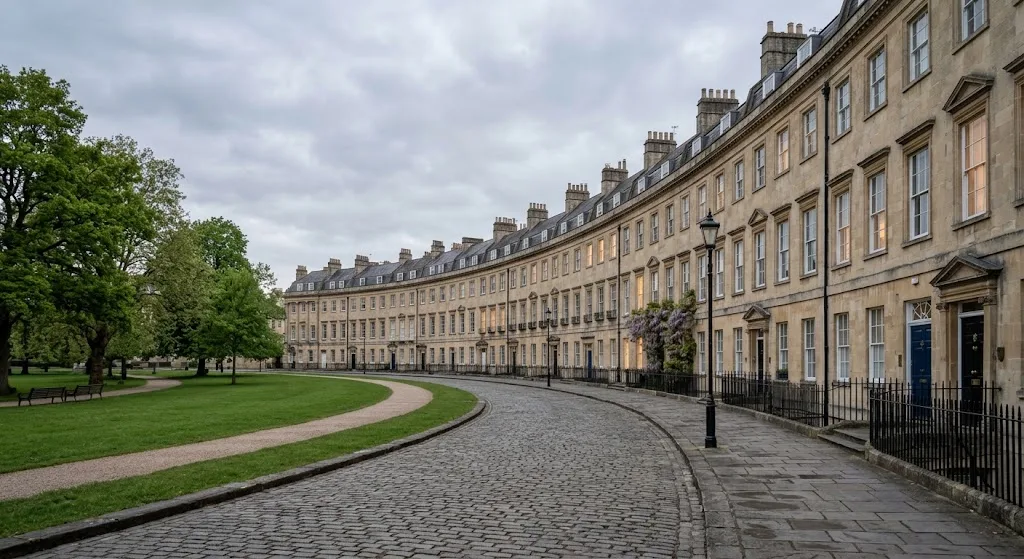
Anyone responsible for non-domestic premises, or the shared parts of a block of flats or HMO, must carry out a fire risk assessment under the Regulatory Reform (Fire Safety) Order 2005. In Bath that covers a mix of buildings few other cities have side by side: historic terraces split into flats, student houses, guest houses and holiday lets, and shops and offices in listed premises. The responsible person is whoever controls the building, which means landlords, employers and managing agents.
Since 1 October 2023 the full assessment must be written down, however small the premises, and the record must name the person who did it and their organisation if it was an outside firm.
Fire safety rules by property type
The rules depend on how the building is used and who lives, works or stays in it. This is the short version for Bath.
| Property | Main fire safety duty | Worth knowing |
|---|---|---|
| Shop, office or workplace | Written fire risk assessment under the Fire Safety Order | Avon Fire & Rescue Service enforces it |
| Guest house, B&B or holiday let | Assessment of the whole premises where guests sleep | People asleep in unfamiliar buildings raises the standard for alarms, escape routes and signage |
| Block of flats (shared parts) | Assessment of the common parts, plus the Fire Safety (England) Regulations 2022 | Fire door checks and resident information are extra duties |
| HMO with 5 or more people | Mandatory HMO licence from the council, plus an assessment of the shared parts | Licensing and the assessment are separate requirements |
| HMO with 3 or 4 people | No additional licence is currently running in Bath | The council has said it is considering the evidence for any future scheme, so check your address |
| Single-let house | Housing law: smoke and carbon monoxide alarms | The Fire Safety Order does not usually apply inside a single-let home |
HMO licensing in Bath
Mandatory HMO licensing applies across the whole of Bath and North East Somerset, for properties occupied by five or more people forming more than one household who share a toilet, bathroom or kitchen. The council puts the number of mandatory licensed properties at around 1,200. Operating without a licence is a criminal offence, with an unlimited fine, or a civil penalty of up to £40,000 per offence. The maximum rose from £30,000 on 1 May 2026 under the Renters’ Rights Act 2025. A flat in a purpose-built block of three or more self-contained flats is exempt from mandatory licensing.
Bath also ran an additional licensing scheme for smaller HMOs of three or four people. It ended on 31 December 2023. In its final report the council said it covered around 1,280 properties, including 823 that had not been licensed before, and that inspections found over 1,000 improvements, including 293 fire alarm upgrades. The council said at the time it was considering the evidence for any future scheme, so a new one would need a consultation first. Check directly with Bath and North East Somerset Council for the latest position on your address. For the council’s licence fees and the documents it asks for, see what an HMO licence costs in Bath. Our HMO fire safety guide covers how licensing and the assessment fit together.
The council's fire standards for licensed HMOs
Bath and North East Somerset Council publishes its HMO licensing standards, and the August 2026 edition sets out what it expects on fire safety. The standards vary with the number of storeys, so the first question for any Bath HMO is how many floors it has. This is a summary. Check the council's current standards document before you buy or fit anything.
| Item | What the council's standards say |
|---|---|
| Fire alarm | Category D1-LD2 system to BS 5839-6 in HMOs of 1 to 4 storeys. Category D1-LD1 for bedsits of 3 or more storeys and for other HMOs of 5 or more storeys. |
| Kitchen doors | FD30s with a self-closer in every HMO, whatever the number of storeys. |
| Living room and bedroom doors | 1 to 2 storeys: solid core (bedrooms) or solid core or sturdy panel (living rooms). 3 storeys: self-closing. 4 storeys: FD30 with a self-closer. |
| Hinges and locks | Must not melt below 800°C. Hollow “egg box” doors and non-fire-resisting glazed doors are not accepted. |
| Emergency lighting | Generally not needed in 1 to 3 storey HMOs unless the fire risk assessment asks for it or the escape route is complicated or dark. Required to BS 5266-1 in HMOs of 5 or more storeys. |
| Fire blankets and extinguishers | A BS EN 1869 fire blanket in each room with a kitchen. Extinguishers are no longer required, and if provided they must be serviced annually and tenants trained. |
| Fire risk assessment | Mandatory for HMO licensing and must be carried out by a competent person. |
An FD30s door is a 30-minute fire door with integrated flexible smoke and heat seals and a self-closer that meets BS EN 1154 at a minimum of power size 3. Alarm power through key, card or coin meters is not permitted. Our fire door inspections page covers how a fire door is checked.
Planning permission and the Article 4 direction
Converting a family home into an HMO in Bath usually needs planning permission. The council’s Article 4 direction covers the whole of Bath and has done since 2013. It removes permitted development rights for changing a family home into a house in multiple occupation, so a planning application is needed. Under the council’s HMO planning guidance, an application can be refused if it would take HMOs to 10% or more of households within 100 metres. This sits on top of licensing and the fire safety duty, not instead of them.
The council describes HMOs as traditionally more concentrated in the wards of Oldfield, Westmoreland and Widcombe, so the 10% test matters most there. Planning rules and licensing rules are separate, so a property can be licensed and still lack planning permission.
Listed buildings and fire safety
A listed building can need consent for fire safety work. Bath is a World Heritage Site, and much of the city’s housing stock is listed or in a conservation area. Altering a listed building’s character without consent is a criminal offence, so a fire door upgrade or other alteration may need consent alongside the fire safety work itself.
That matters for HMOs. The council’s standards call for FD30s fire doors with self-closers on kitchens, and fitting one in an original historic door opening is not always a like-for-like swap. Raise it early. The assessment tells you what the building needs, and the council’s conservation team tells you what you are allowed to change.
What Avon Fire & Rescue looks at in an audit
Avon Fire & Rescue Service enforces the Fire Safety Order. When an officer audits a premises they usually ask to see the fire risk assessment, fire system testing and maintenance records, the electrical installation condition report, emergency procedures, and staff training and fire drill records. They also look at escape routes, fire doors, the alarm panel and detection, emergency lighting and signage.
Outcomes range from satisfactory to formal notices (enforcement, prohibition or alteration notices). The service describes its approach as “coach to comply”, and a breach of the Order is a criminal offence that can lead to an unlimited fine.
What the written assessment contains
A written record of the hazards found, who is at risk, what is already in place, and a prioritised list of actions. It names the person who carried out the assessment. That document is what a licensing officer, insurer or enforcing officer will ask to see.
Keeping the assessment up to date
The assessment must be kept under review, with no fixed expiry date. A change of tenancy, an extra letting room, works to the building, a new alarm or emergency lighting installation, or a licence renewal are common reasons to revisit it. An out-of-date assessment is treated the same as no assessment at all. See FRA reviews for what triggers a fresh one.
Who carries out the assessment
We connect you with our assessor, who covers Bath as well as Bristol. Once your enquiry is passed on you deal with them directly: they confirm the details, arrange the visit and provide the written report.
Frequently asked questions
My property doesn't need an HMO licence any more, does it still need an assessment?
Yes. The fire risk assessment is a separate duty under the Fire Safety Order, it doesn’t depend on whether the property currently needs a licence.
Will a listed building always need extra work?
Not always, but it’s worth checking. Any physical alteration, not just fire safety work, can need consent in a listed building, so it’s worth raising early rather than after the assessment.
Who is the responsible person in a shared building?
The person who has control of the premises: the employer, the owner, or the managing agent. In a building with several occupiers, each is responsible for their own space and they have to cooperate on the shared parts such as stairs and corridors.
Can I carry out my own fire risk assessment?
The law allows it if you are competent to do it, meaning you have the knowledge, training and experience for the building. For a small, simple premises that can be realistic. For an HMO, flats or anywhere with shared escape routes, most responsible persons bring in an assessor.
How much does a fire risk assessment cost in Bath?
Typical published prices run from about £200 to £600 for a small HMO, flat, shop or office, and rise for larger buildings. These are not a quote. See our cost guide for the ranges and what moves the price.
ENQUIRY
Tell us about your Bath property.
Landlords, HMOs and businesses across Bath: share a few details and we’ll get back to you about an assessment.
Or call 0117 463 7863.
Or email hello@fire-risk-assessment-bristol.co.uk.
BRISTOL & BATH