
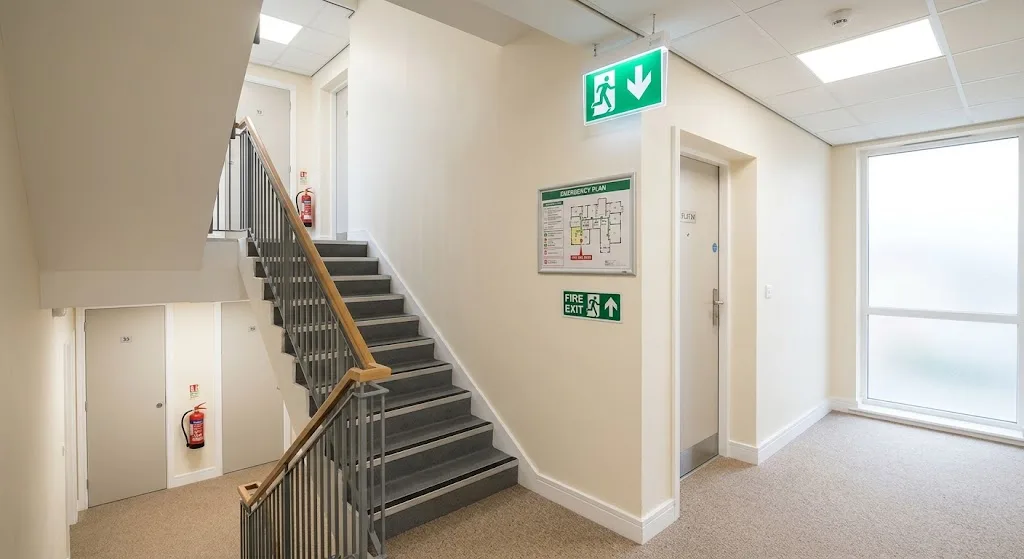
EVACUATION STRATEGIES
Fire evacuation strategies in Bristol: stay put, simultaneous and phased
How a building’s evacuation strategy is chosen, what each type means, and what landlords and employers must tell the people who use it.
What is a fire evacuation strategy?
An evacuation strategy is the plan for how people leave a building, or stay put, when the alarm sounds. It is decided by the fire risk assessment, not picked from a menu: the layout, how many people use the building, how it is built and who needs help getting out all point to one approach. Our assessments record the strategy and the reasons for it.
What are the types of evacuation strategy?
These are the four approaches you will see named in fire safety guidance, and where each tends to fit.
| Strategy | How it works | Often used in |
|---|---|---|
| Simultaneous | Everyone leaves the building as soon as the alarm sounds | Offices, shops, HMOs and converted buildings with a single stair |
| Stay put | People not affected by the fire stay in their own flat unless told otherwise, because the building is built to contain fire | Purpose-built blocks of flats |
| Phased | Floors leave in a set order, usually the fire floor and the one above first | Larger buildings with a voice alarm system |
| Progressive horizontal | People move through fire doors to a safe adjoining area on the same floor | Care homes and buildings where people cannot easily use stairs |
Who decides which strategy a building uses?
The responsible person is accountable, and the fire risk assessment is where the decision is recorded. It is based on the building’s construction and layout, the fire detection and alarm system, and who is in the building. A strategy can be changed if the building or its occupants change, which is one reason the assessment must be kept under review.
What if a stay put building is no longer safe?
Stay put only works while the building’s fire separation is intact. Where that has been compromised, for example by damaged fire doors or defective walls, the strategy may have to change, and interim measures such as a waking watch have been used while the work is done. That is a decision for the assessment and the fire service, not something to improvise.
What do landlords have to tell residents?
Under the Fire Safety (England) Regulations 2022, in force from 23 January 2023, the responsible person of any multi-occupied residential building with common parts must give residents key fire safety instructions based on the building’s evacuation strategy, including how to report a fire and what to do in one. They must also give residents information about the importance and operation of fire doors, and provide it annually.
Are there extra rules for high-rise buildings?
Yes. For buildings over 18 metres, or with seven or more storeys, the Regulations add duties including a secure information box with floor plans, electronic floor plans for the fire and rescue service, wayfinding signage in stairwells, and regular checks of firefighting equipment and lifts. Buildings over 11 metres must also have communal fire doors checked quarterly and flat entrance doors annually. See fire door inspections.
What about people who cannot leave unaided?
The assessment has to consider anyone who regularly works in or visits the building and would need help getting out. A personal emergency evacuation plan (PEEP) records the help that person needs. It is part of the strategy, not an extra.
Frequently asked questions
What is the difference between stay put and simultaneous evacuation?
In a stay put building, residents not affected by the fire remain in their flats unless told to leave, because the structure is designed to contain fire. In a simultaneous evacuation, everyone leaves as soon as the alarm sounds.
Does every building need an evacuation strategy?
Every building covered by the Fire Safety Order needs one in effect, because the assessment has to deal with how people get out. For small premises it may be a simple recorded statement; for larger or more complex buildings it is more detailed.
Who writes the evacuation strategy?
It is recorded in the fire risk assessment by the competent person who carries it out. For a new building the design-stage strategy sits in a fire strategy report.
Do the 2022 Regulations apply in Bristol and Bath?
Yes. They apply in England to multi-occupied residential buildings with common parts. They do not apply in Wales.
How often must residents be given fire safety information?
Annually, under the Fire Safety (England) Regulations 2022, for buildings with two or more sets of domestic premises sharing common parts.
Can the strategy change after the assessment?
Yes. A change to the building, its fire doors or alarm system, or the people using it can mean the strategy needs revisiting, and the assessment has to be updated to match.
ENQUIRY
Tell us about your building.
Landlords, managing agents and businesses across Bristol and Bath: share a few details and we’ll get back to you.
Or call 0117 463 7863.
Or email hello@fire-risk-assessment-bristol.co.uk.
BRISTOL & BATH