HMOS & SHARED HOUSES
Does my Bristol HMO need a fire risk assessment as well as a licence?
Fire risk assessments for HMOs and shared houses across Bristol and Bath, covering licensing and the written record the law requires.
Does my HMO need a licence in Bristol?
Any HMO with five or more people is covered by mandatory licensing across the whole of Bristol. Smaller HMOs of three or four people need an additional licence too, either under the citywide scheme running since 6 August 2024, or under the earlier scheme covering Bedminster, Brislington West and Horfield, which has run since 6 April 2022. Some non-HMO rentals in these areas also need a selective licence, regardless of the number of tenants. For the council’s fees, see what an HMO licence costs in Bristol.
| Licence | Who it covers | Where |
|---|---|---|
| Mandatory | HMOs with five or more people | Whole of Bristol |
| Additional | HMOs with three or four people | Citywide since 6 August 2024; earlier scheme in Bedminster, Brislington West and Horfield since 6 April 2022 |
| Selective | Some other private rentals, whatever the number of tenants | Bedminster, Brislington West, Bishopston and Ashley Down, Cotham and Easton |
Is a fire risk assessment the same thing as an HMO licence?
No. The licence and the fire risk assessment are separate legal requirements. The Fire Safety Order requires an assessment of the shared parts regardless of whether the property is licensed. Bristol’s application page does not list an assessment as a required document, but the council publishes its own fire safety standards for licensed HMOs, and a fire risk assessment by a competent person can be submitted for the council’s approval as an alternative to its tables.
What does an HMO fire risk assessment look at?
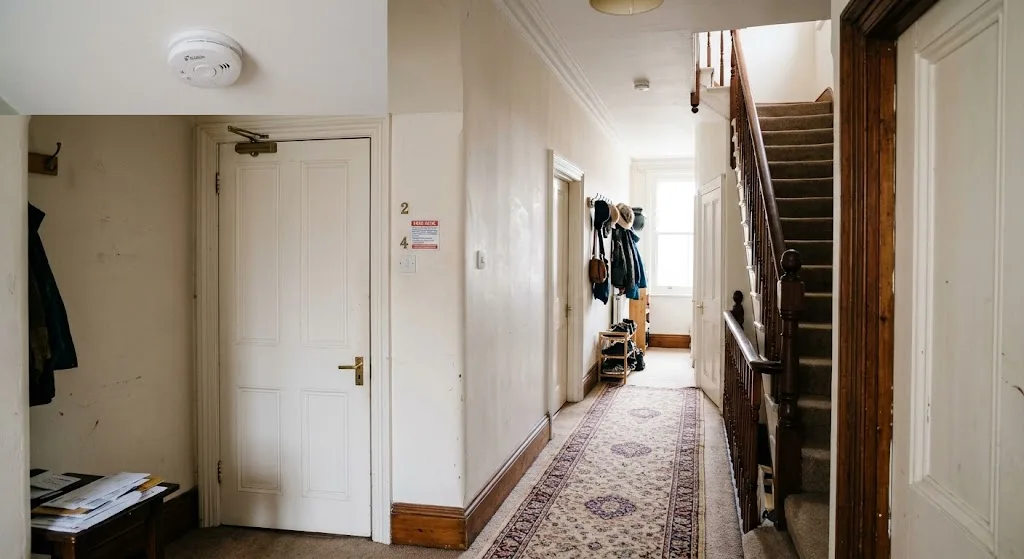
The assessor walks the whole building and records what is in place and what is missing. For a shared house that usually means the escape route from every bedroom, the protection on that route, the fire alarm and its coverage, emergency lighting where it is needed, the kitchen, and anything stored in hallways or on stairs.
It also covers how the building is managed: whether alarms and doors are tested and maintained, whether tenants are told what to do in a fire, and whether anyone living there would struggle to get out unaided.
What makes an HMO assessment different from a single-let one?
The main difference is the shared spaces and multiple households. An HMO assessment looks closely at individual bedroom fire doors, shared kitchens and bathrooms, and the single escape route several unrelated occupants rely on together, rather than one household’s own exits.
What fire alarm standard does my HMO need?
It depends on the property’s size and layout, not a fixed rule. Bristol City Council’s fire safety standards for licensed HMOs use BS 5839-6 and set the grade by the number of storeys and people sharing. For a shared house of one to three storeys with up to six people the council’s table asks for a Grade D1 LD2 system, and LD1 for seven or more or at four storeys. Bedsits and bed/living rooms are LD1. The detectors are interlinked and mains-powered with battery backup. The council’s document is undated, so check it with the council before you buy anything. A fire risk assessment then records whether the system in place suits the building. See the council’s standards in full.
Do I need planning permission to convert a property into an HMO?
In parts of Bristol, yes. Article 4 directions remove the usual permitted development rights for converting a family home into a small HMO in certain areas. This sits alongside, not instead of, the licensing and fire safety requirements.
When does an HMO fire risk assessment need updating?
Common triggers are a change of tenants, an additional letting room, new fire doors or alarm work, or a licence renewal. The assessment has no fixed expiry date and needs regular review, but an out-of-date one is treated the same as having none.
Are student HMOs assessed differently?
The legal requirements are the same, but the assessment has to account for how the property’s actually used. Higher cooking activity, annual tenant turnover, and inconsistent response to fire alarms are common factors in student housing, which affects what the assessment recommends in practice, not the underlying duty itself.
What do I get at the end?
A written report that names the assessor, records the hazards and who is at risk, and lists the actions in priority order. It is the record an insurer or enforcing officer may ask to see. The visit is carried out by our assessor, who covers Bristol and Bath.
Frequently asked questions
Do I need both a mandatory and an additional licence?
No single property needs both at once, mandatory licensing applies at five or more occupants, additional licensing covers smaller HMOs of three or four. Which one applies depends on how many people live there.
My HMO is in Horfield, does that mean I need a selective licence too?
No. Horfield has additional licensing for HMOs, but not selective licensing. Selective licensing in Bristol currently applies in Bedminster, Brislington West, Bishopston and Ashley Down, Cotham, and Easton.
Can the same visit cover both the licence evidence and the fire risk assessment?
Often, yes. Since both look closely at fire doors, alarms and escape routes, one visit can usually gather the evidence needed for both.
Does Bristol require a fire risk assessment with an HMO licence application?
The council’s application page does not list one as a required document. Its fire safety standards set what it expects in a licensed HMO, and a fire risk assessment by a competent person can be submitted for council approval as an alternative to those tables. The Fire Safety Order duty applies separately. If you are unsure, ask the council on private.housing@bristol.gov.uk.
Is HMO licensing in Bath the same as in Bristol?
No. Bath and North East Somerset has mandatory licensing only, and its additional licensing scheme finished on 31 December 2023. See the Bath page for how that works.
Does the assessment have to be written down?
Yes. Since 1 October 2023 the full assessment must be recorded in writing, however small the premises.
Who enforces fire safety in a Bristol HMO?
Avon Fire & Rescue Service enforces the Fire Safety Order for most premises in Bristol. Licensing conditions are separately enforced by the council.
How much does an HMO fire risk assessment cost?
A small HMO or shared house is typically about £250 to £600 in published prices, and larger or multi-storey HMOs start from about £500. These are typical published prices, not a quote. See our cost guide.
ENQUIRY
Tell us about your HMO.
HMOs and shared houses across Bristol and Bath: share a few details and we’ll get back to you about an assessment.
Or call 0117 463 7863.
Or email hello@fire-risk-assessment-bristol.co.uk.
BRISTOL & BATH