LANDLORDS · GUIDE
What smoke and carbon monoxide alarms does a Bristol rented home need?
The rules for every private let in England, plus the extra conditions for licensed homes in Bristol.
What smoke and carbon monoxide alarms does a Bristol rented home need?
Since 1 October 2022, private landlords in England must fit at least one smoke alarm on every storey with a room used as living accommodation, and a carbon monoxide alarm in any room used as living accommodation that has a fixed combustion appliance. Gas cookers are excluded. Check the alarms work on the day each new tenancy begins, and repair or replace any that a tenant reports as faulty. If a landlord fails to comply with a remedial notice, the council can fine up to £5,000.
Source: GOV.UK, Smoke and Carbon Monoxide Alarm (England) Regulations 2015 Q&A booklet for the private rented sector, as amended in 2022, read 12 November 2026.
Which appliances need a carbon monoxide alarm?
A fixed combustion appliance is fixed equipment that burns fuel of any type to make heat. Gas and oil boilers and log-burning stoves are examples. Gas cookers are excluded, and the government's view is that a decorative fireplace that does not work does not count.
Where should the alarms go?
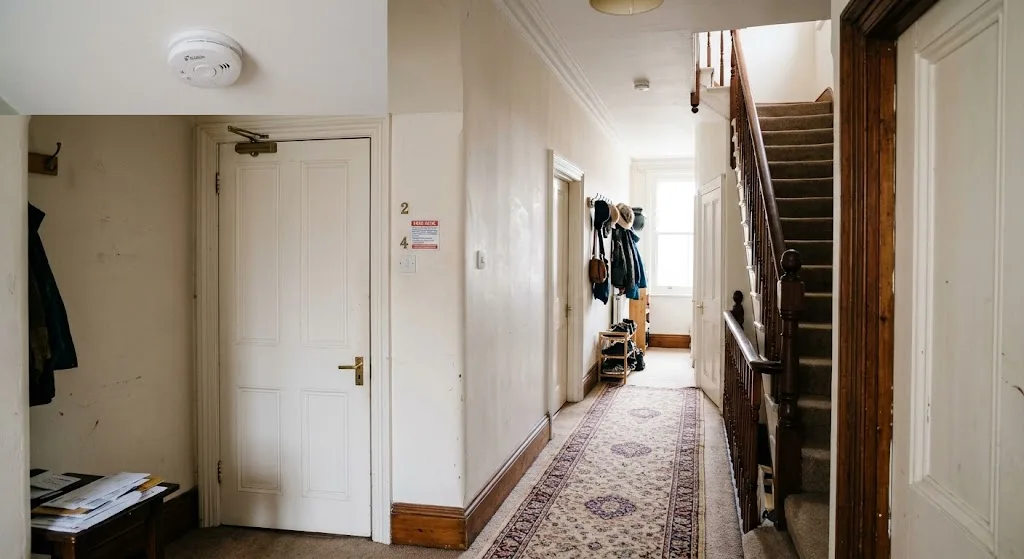
The regulations do not say. The government's booklet suggests fixing smoke alarms to the ceiling in a circulation space, such as a hall or landing, and fitting carbon monoxide alarms at head height, about one to three metres from the appliance. Follow the manufacturer's instructions as well.
What do Bristol's licence conditions add?
Homes under Bristol's selective licensing, in Bishopston and Ashley Down, Cotham and Easton, have extra conditions. The council's published conditions ask for a smoke alarm on each storey used as living accommodation and a carbon monoxide alarm in any living room with a fixed combustion appliance other than a gas cooker, both kept in working order and checked on the day a new tenancy begins. On request, you must give the council a declaration about the alarms, a gas safety certificate from the last 12 months, and electrical safety evidence. You must also give tenants written fire evacuation procedures. The council says on request means within 28 days unless stated otherwise.
Source: Bristol City Council, selective licensing conditions, read 12 November 2026. The copy we read carries no date in its text, so check the current version with the council.
Is it different for an HMO?
Yes. Licensed HMOs in Bristol follow the council's own fire safety standards, which set the alarm grade by the number of storeys and people sharing, usually with interlinked alarms powered from the mains with battery backup. See what Bristol council expects in a licensed HMO.
What should I keep on file?
The government's booklet advises keeping a record of when alarms are tested. A simple note with the date, each alarm's location and the result is enough, and it is what the council may ask to see if your home is licensed. A fire risk assessment of any shared parts will also look at the alarms. For single lets and flats, see landlords and flats.
Frequently asked questions
Does a gas cooker need a carbon monoxide alarm?
No. Gas cookers are excluded. Boilers, oil boilers and log burners are not.
When do I have to test the alarms?
On the day each new tenancy begins. Renewals of an existing tenancy do not count as new tenancies.
Who replaces the batteries?
The government's booklet advises tenants to try new batteries first. If an alarm still does not work, the tenant should report it, and the landlord must repair or replace it.
What's the penalty for not fitting alarms?
The council can serve a remedial notice. If the landlord fails to comply, it can fine up to £5,000.
Is it the same in Wales?
No. Wales has its own rules for rented homes.
Does the law say what type of alarm to fit?
The regulations do not specify where alarms go. For licensed HMOs, the council's standards set the type and grade.
ENQUIRY
Tell us about your property.
Rented homes across Bristol and Bath: share a few details and we’ll get back to you about an assessment.
Or call 0117 463 7863.
Or email hello@fire-risk-assessment-bristol.co.uk.
BRISTOL & BATH